





Can a robot do this task?

Get the answer in hours, not weeks. From a phone video.

Misko turns a phone video of a workstation into a feasibility study for automating it with robots.

Tell me your case How it works

The challenge

Every automation project starts with the same question: can a robot do it? Often, factories don't even consider automating because they assume it's too expensive. Other times, they want to automate but don't know who to ask.

Factories

Most factories can't run a feasibility study on their own, so many good automation ideas never get past that first question.

Find out if a process can be automated before calling anyone.

  • Record and upload a video of the workstation and the process
  • Compare robots and options
  • Design your solution and simulate its cycle times

System integrators

A feasibility study takes weeks and is often given away for free in pre-sales, before any contract is signed.

Stop doing feasibility studies for free.

  • Answer pre-sales questions with far less engineering time
  • Qualify opportunities early to know which projects are worth it
  • Send your customers a clear, professional report
  • Once validated, deploy the real cell faster

How it works

Misko is designed to cover every stage of an industrial robotics project, from idea to deployment. Each stage delivers value on its own.

  1. Prototype stage

    Data capture

    Record the workstation with a phone. The video becomes a 3D model you can adjust and scale, ready to work on directly in the simulator.

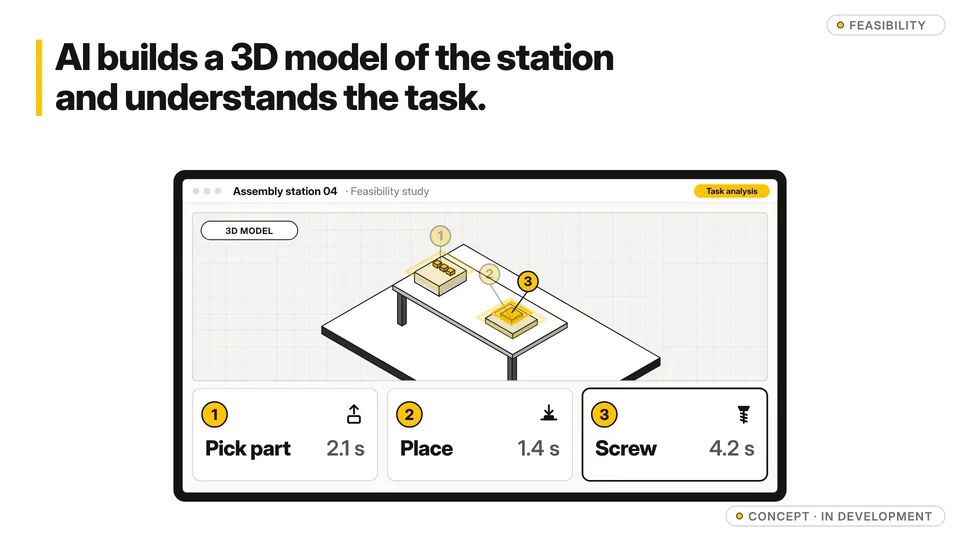
  2. Concept illustration: a 3D model of the station with the detected steps pick part, place and screw, and their times.

    Concept stage

    Task identification

    AI breaks the manual task down into steps (pick, place, screw…) and identifies the automation potential of each one. Since it starts from a recording of the real process, it can analyse the required cycle times and estimate the return on investment. From there, it can suggest hardware and pre-program the simulation.

  3. Prototype stage · Previously validated

    Simulation

    An online simulator lets you try different robots and components (parts, actuators, cameras, sensors…) and check reach, collisions and cycle time. It's not the first time I've built this: at drag&bot, my previous company (acquired by KEBA), we developed a simulator whose cycle times deviated less than 10% from reality. Misko rebuilds it from scratch with today's technology.

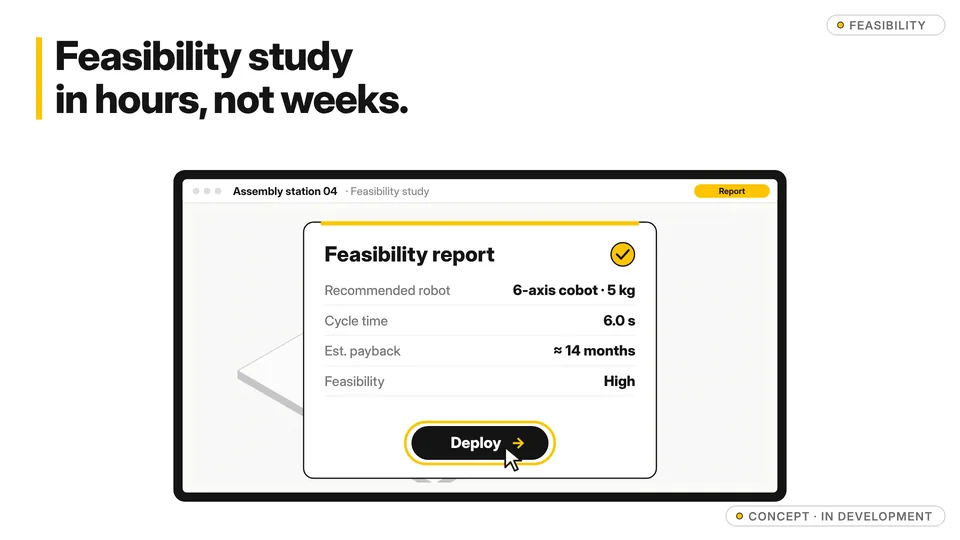
  4. Concept illustration: a feasibility report with the recommended robot, cycle time and a deploy button.

    Concept stage

    Decision

    Get a feasibility report: is it feasible? With which robot? What cycle time and return can you expect? If you're a factory, decide with data and talk to integrators knowing what you need. If you're an integrator, present your customer a clear proposal before the quote.

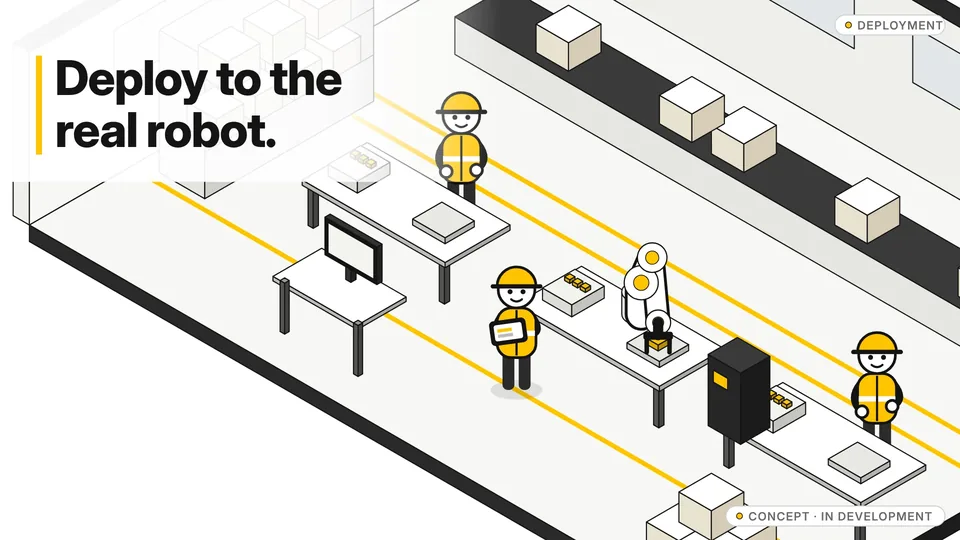
  5. Concept illustration: the real robot working at the station while an operator supervises with a tablet.

    Concept stage · Previously validated

    Deployment

    Once the simulation is validated, turn it into a program for the real robot. There are two paths: generating native code for each manufacturer's controller, or running it on a universal controller. At my previous company, drag&bot, we chose the universal one. With Misko, the goal is to generate the program directly for the robot's own controller. Integrator partners install the cell.

Where Misko is today

Misko started in 2026 as a personal project, built in public and AI-native from day one. The goal: help more factories answer the question "can this be automated with robots?".

Why now? Advances in AI make it possible to bring tools to industry that used to require a large team and years of development. Today, one experienced person can build a first prototype in weeks.

Misko is in development. Each stage is built separately and prioritised by the value it delivers. I'll keep sharing progress.

Who’s building it

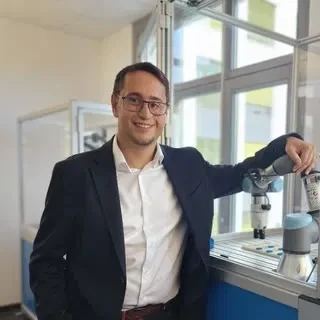
Portrait of Pablo Quilez next to a robot arm.

Pablo Quilez · Zaragoza

14+ years in robotics and software. Five years of R&D at Fraunhofer IPA, then co-founder and CTO of drag&bot, a Fraunhofer spin-off for simple, manufacturer-independent programming of industrial robots, acquired by KEBA in 2021. I led the engineering team and took the product from first prototype to customers' factories: installation, commissioning, training and support with the main robot brands. I combine robotics and software with a business perspective, and I work in Spanish, English and German.

View LinkedIn profile →

  • Education:
  • Universidad de Zaragoza
  • Technische Universität Braunschweig
  • UNIR – Universidad Internacional de La Rioja
  • Experience:
  • Fraunhofer
  • drag&bot
  • KEBA

Get involved

Misko is at the concept and prototype stage, and I'm building it in public from Zaragoza, Spain. Concept · in development

Pilot projects

I'm looking for a limited number of pilot projects to test and validate the technology. If you're a factory or an integrator, tell me about your case or send me a video of the workstation; I'll select the best fits. Open to projects in any country.

Propose a pilot

Co-founders and collaborators

At this stage I'm open to meeting people who want to build this from the ground up, with a stake in the project: AI, robotics or industrial business development.

I want to build it

Investors and partners

Today Misko is self-funded and pre-commercial. I'm open to talking with pre-seed investors and strategic partners in industrial AI and robotics.

Let’s talk